

The Purpose of Public Notices
The core principle of public notice is simple: citizens cannot hold government accountable if they are unaware of proposed government actions.
Public notice is not a formality; it is the mechanism that allows Pennsylvanians to weigh in on matters that directly affect their lives like budget proposals, school curriculum plans, zoning changes, tax increases, environmental permits, permanent school closures and countless other issues that have a direct impact.

The History of Public Notices in Pennsylvania
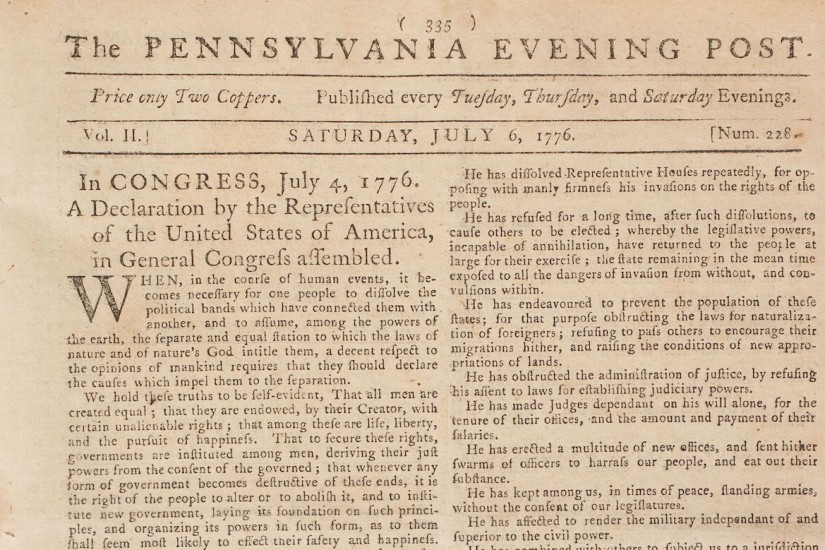
Public notices have been published in Pennsylvania newspapers for centuries; in fact, the Declaration of Independence was a public notice published in the Pennsylvania Evening Post on July 6, 1776.
In the commonwealth, public notices are governed by the Newspaper Advertising Act, which requires public notices be published in printed newspapers of general circulation. More specific statutes dealing with a variety of subjects often contain more detailed notice requirements. Public notices are published in newspapers because they are an independent, third party whose constitutional role is to inform their community and hold government accountable.
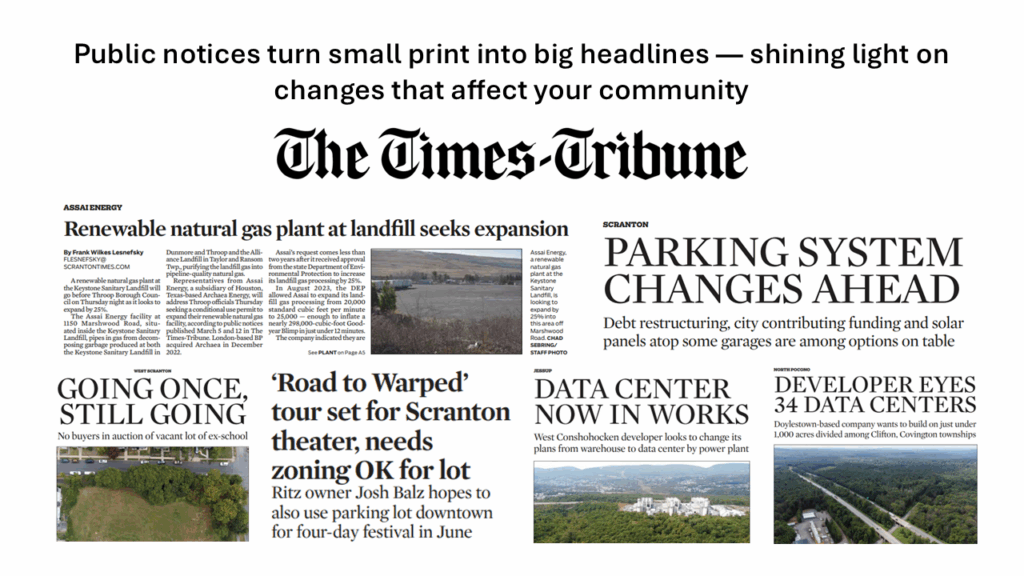
Print Plus Digital for the 21st Century
Pennsylvania’s news media environment has evolved rapidly in the digital age. Maximizing the reach of public notices can be achieved by creating a simple layered public notice process that preserves printed public notice, requires public notice to be on a newspaper’s website in front of paywalls, and posted to a centralized statewide public notice website at no additional cost to taxpayers.
Pennsylvania newspapers have widespread print circulation, but if a newspaper moves to digital-only distribution based on market conditions and community demand, public notices can be published in digital newspapers and, in certain cases, free or online-only newspapers embedded in their communities. This flexible, layered approach is the best way to address the media landscape and persistent digital divide, a significant and ongoing issue in Pennsylvania.

- 1.3 million households ‒ over a quarter of the state ‒ are “digitally excluded.”1
- 300,000 addresses remain completely unserved by broadband.2
- Among older adults in Philadelphia, only about two-thirds subscribe to broadband, and
nearly half do not own a working computer or tablet.3 - In rural Pennsylvania, more than 1 in 10 households have no internet access at all, and many with service face slow, less reliable connections. 4 5
PNA Supports HB 1291
Pennsylvania law gives the public three ways to understand government and hold it accountable – public meetings, public records and public notices.
Public notices tell citizens which meetings to attend and which records to request. Any legislation making public notices difficult to access or puts them under complete government control is bad public policy. News organizations provide an independent step in the public notice process, safeguarding the public interest, and preventing the government in self-policing its compliance with laws that require it to tell the public of plans before decisions are made. Public notices have a direct impact on the public’s voice in government.
The process must be independent, accessible to all and permanent. News organizations have provided these safeguards for generations.
PNA supports HB 1291, the modernization of the Newspaper Advertising Act.
Trust In Local Journalism
Eighty-five percent of Pennsylvania registered voters say they have the most trust in local newspapers, print and online; that level of trust surpasses other news media outlets.
The 2022 survey conducted by Public Opinion Strategies of Alexandria, Virginia, for the Pennsylvania NewsMedia Association provides additional good news about public notice in print newspapers, government transparency, and the essential role local journalism plays in the health of communities across the commonwealth:

- 92% favored state law requiring public notices to be published in print editions of local newspapers to alert citizens about important local issues – like zoning changes, school closures, and environmental proposals that impact health and property –before government takes action.
- 92% favored expanding the Right-to-Know Law, which provides citizens access to public records held by government agencies.
- 85% said they have the most trust in local newspapers, print and online. That level of trust surpasses other news media outlets.
- 87% said local newspapers are key to an informed community because they cover local issues such as business, politics and public safety. This is the kind of news readers cannot get anywhere else.
- 87% said local newspapers help keep people connected to their communities.
Search public notices in Pennsylvania
The website linked below is a compilation of public notices published throughout the Commonwealth of Pennsylvania. It is a public service made possible by the newspapers of Pennsylvania at no cost to taxpayers. This easy-to-use website is designed to assist citizens who want to know more about the actions of local, county and state government, as well as events occurring in the local and state court systems.